Email: info@allterrainforklift.cn WhatsApp: +86 13053557263
Language:  ∷
∷ 
∷  ∷
∷ 
Time:2026-08-24 14:37:08 Read:150
A rough terrain forklift is an industrial handling vehicle specifically designed for unpaved surfaces. Equipped with four-wheel drive, large-diameter pneumatic tires, and high ground clearance, it operates reliably in mud, gravel, and on slopes – conditions where standard forklifts simply cannot perform safely.
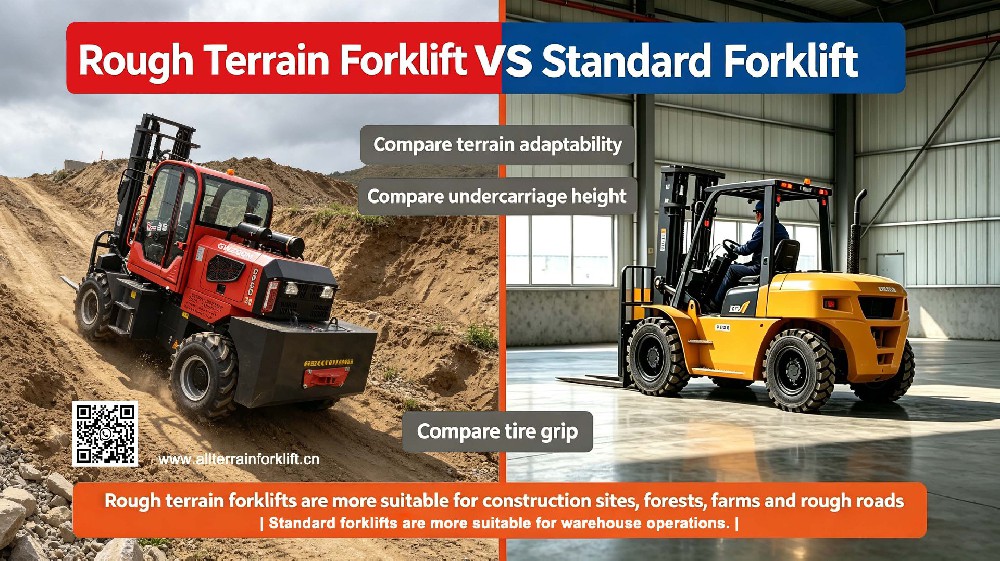
A rough terrain forklift – also known as an all-terrain or off-road forklift – is a specialized industrial truck used for loading, unloading, stacking, and transporting materials on unprepared natural ground. It combines strong off-road capability, maneuverability, and reliability, making it the ideal choice for job sites that are inaccessible to conventional warehouse forklifts.
While the basic structure resembles a standard counterbalance forklift – with an engine, chassis, mast, hydraulic system, and electrical components – every part is reinforced and optimized for harsh outdoor conditions. From the drivetrain to the suspension, the design philosophy revolves around all-terrain adaptability.
Feature | Rough Terrain Forklift | Standard Forklift |
Drive System | Two-wheel drive (rear-wheel driven) | |
Surface Type | Concrete, asphalt, warehouse floors | |
Tire Type | Solid cushion tires or smooth tread | |
Ground Clearance | 100-150mm | |
Power System | Lower power output; diesel/electric/LPG | |
Typical Applications | Warehouses, factories, logistics centers, paved yards | |
OSHA Classification | Class I-V (indoor / improved surfaces) |
1. All-Wheel Drive for Superior Traction
Most rough terrain forklifts feature full-time or part-time 4WD. Combined with wide-base pneumatic tires, they maintain excellent traction on mud, sand, and snow – surfaces where two-wheel-drive machines spin out and get stuck.
2. High Ground Clearance
With a minimum ground clearance of 250mm and approach/departure angles exceeding 30°, these machines easily clear rocks, roots, potholes, and debris without undercarriage damage.
3. Powerful Diesel Engines
Equipped with high-output diesel engines known for thermal efficiency and high torque output, rough terrain forklifts can climb gradients of 25° to 35° – far beyond what standard forklifts can handle. Some models can even wade through water depths exceeding 0.5 meters.
4. Reinforced Chassis for Stability
Thickened box-section frames, wider wheelbases, and low-center-of-gravity designs ensure stability when lifting heavy loads on slopes and uneven surfaces – critical for safe operation in challenging terrain.
5. High Travel Speed
Rough terrain forklifts can reach speeds of 30-40 km/h, with acceleration and maneuverability that outperform standard models in outdoor environments.
6. Multi-Function Attachments
Quick-change attachments – forks, buckets, log clamps, booms, drum handlers – can be swapped in under five minutes, transforming one machine into a versatile tool for multiple tasks.
The core value of a rough terrain forklift lies in solving the "last mile" material handling challenge on unprepared ground. These industries rely heavily on them:
Industry | Typical Applications | Key Requirement |
Construction | Moving materials on muddy or gravel sites | Traction + Stability |
Mining | Slope transport, ore handling, heavy loads | Power + Durability |
Agriculture/Farming | Feed and crop handling on soft, muddy fields | Flotation + Grip |
Ports/Docks | Container yard operations on unpaved areas | Corrosion resistance + Heavy load |
Lumber/Forestry | Log handling at sawmills and forest sites | Attachment versatility |
Municipal/Waste | Landfill and public works projects | All-weather operation |
Whether you need to move materials on a muddy construction site or haul heavy loads up a mine slope, a rough terrain forklift delivers solutions that standard machines simply cannot.
Q: Can a rough terrain forklift operate on concrete?
Yes. Rough terrain forklifts work on both unpaved and paved surfaces. However, pneumatic tires wear slightly faster on smooth concrete than solid cushion tires – so balance usage based on your actual operating conditions.
Q: What load capacities are available?
Common models range from 1.5 to 15 tons, with 3 to 10 tons being the most popular range for construction and mining applications. Selection should consider both load weight and slope gradient.
Q: Are 4WD rough terrain forklifts significantly more expensive?
The 4WD system and reinforced components add to the initial cost. However, the improved productivity, reduced downtime, and enhanced safety in tough conditions typically deliver a higher long-term ROI.
Q: Do operators need special training for rough terrain forklifts?
Yes. Rough terrain forklifts are specialized equipment requiring operator training and certification – particularly for slope operation and uneven terrain driving techniques that differ significantly from standard forklift operation.
WhatsApp: +86 130 5355 7263
Phone:+86 130 5355 7263
Email: info@allterrainforklift.cn
Add:Shahe Town Industrial Park, Laizhou City, Shandong Province
We chat