Email: info@allterrainforklift.cn WhatsApp: +86 13053557263
Language:  ∷
∷ 
∷  ∷
∷ 
Time:2026-09-09 15:31:11 Read:35
Choosing the right forklift capacity is not simply a matter of matching the machine to the weight of the load. Load center, lifting height, load dimensions, operating conditions, and safety requirements all affect the correct forklift capacity. For outdoor and demanding applications, the terrain and machine configuration are equally important.
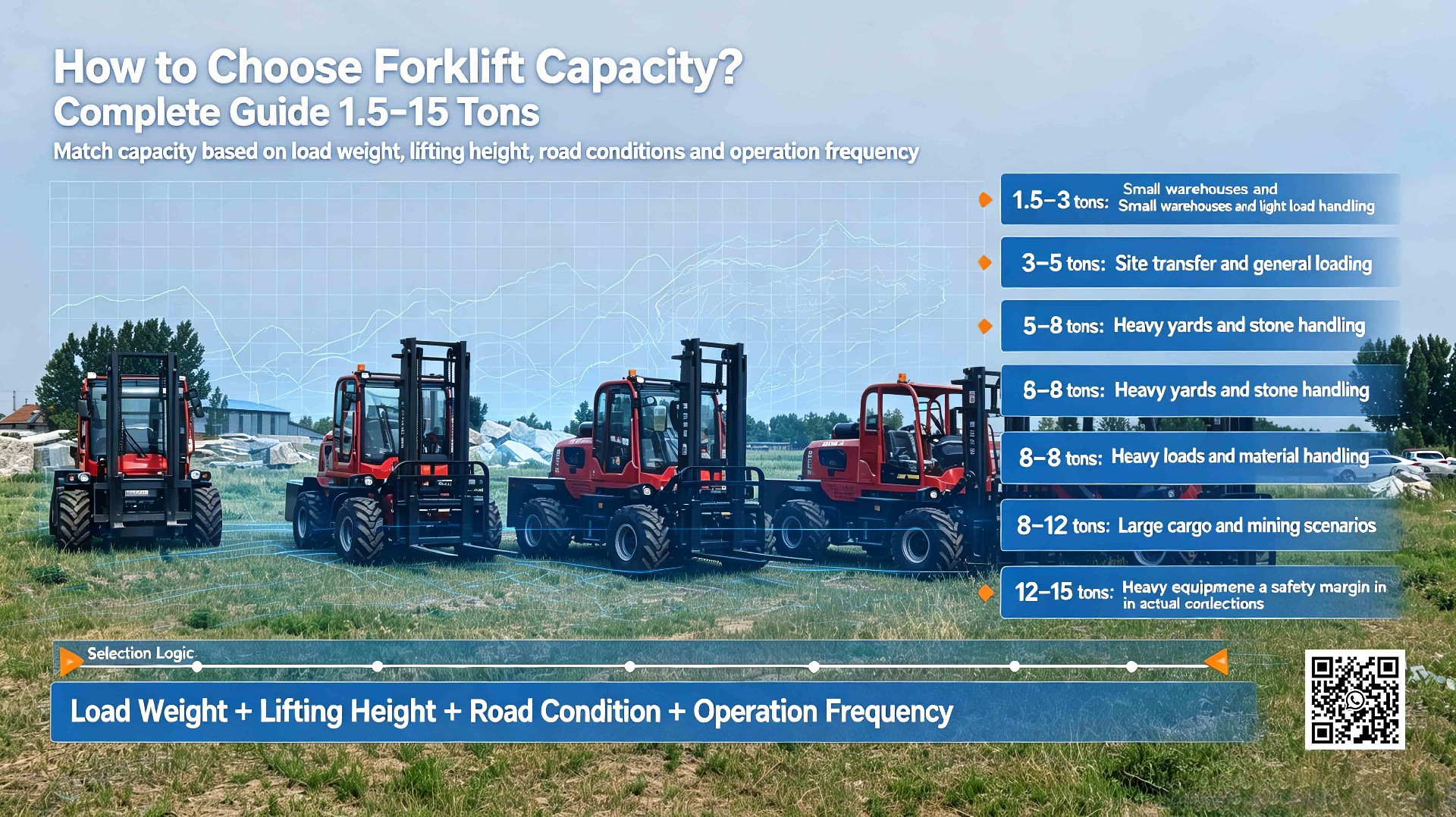
A 1.5-3 ton forklift is suitable for pallets, agricultural materials, building supplies, and other relatively light loads.
For farms, small construction projects, and outdoor material handling where loads are generally below 2-3 tons, a compact rough terrain forklift can provide a practical combination of capacity and maneuverability.
For applications requiring greater flexibility on uneven outdoor surfaces, a 1.5-3 ton rear articulated rough terrain forklift can be considered.
The 3-5 ton range is commonly used for construction materials, steel, timber, machinery, and palletized goods.
If a load weighs approximately 3 tons, choosing a forklift rated at exactly 3 tons may not always be sufficient. The load center, fork length, and lifting height can affect the actual lifting capacity.
For demanding outdoor applications, a 3-5 ton heavy-duty rough terrain forklift can be selected according to the actual load and working environment.
When loads become heavier or larger, stability and operating conditions become increasingly important.
A 5-8 ton forklift is suitable for handling steel, stone, engineering materials, large machinery, and other heavy loads. If these operations take place on construction sites, material yards, or uneven outdoor ground, a heavy-duty rough terrain forklift can offer a more suitable solution.
The machine should be selected according to both rated capacity and the actual load center rather than weight alone.
Forklifts in the 10-15 ton range are generally intended for large machinery, steel products, engineering equipment, and other heavy-duty material handling applications.
At this capacity level, buyers should pay particular attention to load center, fork dimensions, lifting height, ground conditions, and operating frequency.
For demanding engineering applications, an integrated engineering rough terrain forklift may be considered when outdoor working conditions and heavy material handling are both involved.
1. Load Weight
The actual weight of the load is the starting point for forklift selection.
2. Load Center
A load positioned farther from the fork face can reduce the forklift's effective lifting capacity.
3. Lifting Height
Higher lifting requirements can affect stability and the machine's available capacity.
4. Working Environment
Indoor concrete floors and outdoor gravel, soil, mud, or uneven terrain require different forklift configurations.
Therefore, how to choose forklift capacity depends on the complete application rather than the load weight alone.
From 1.5 to 15 tons, different forklift capacities serve different material-handling requirements. Light applications may require 1.5-3 tons, general construction and industrial handling often falls within 3-5 tons, while heavier engineering applications may require 5-8 tons or more.
For outdoor operations, buyers should evaluate forklift capacity for outdoor applications together with terrain, maneuverability, stability, and machine configuration.
GWZOOM can recommend suitable rough terrain forklift solutions based on load weight, load center, working environment, and specific application requirements.
1. Is a higher forklift capacity always better?
No. An oversized forklift can increase purchase and operating costs while requiring more working space. The capacity should match the actual application.
2. Does a 3-ton load always require a 3-ton forklift?
Not necessarily. Load center, lifting height, fork length, and operating conditions must also be considered.
3. What forklift capacity is suitable for heavy loads?
Loads above 5 tons generally require a higher-capacity forklift, but the correct model should be determined from the complete load and operating conditions.
4. What should I consider for outdoor forklift applications?
Consider load capacity, terrain, ground conditions, load center, maneuverability, and the required working frequency.
5. Can GWZOOM help select the right forklift capacity?
Yes. The recommended forklift can be matched to the customer's load, working environment, operating space, and application requirements.
WhatsApp: +86 130 5355 7263
Phone:+86 130 5355 7263
Email: info@allterrainforklift.cn
Add:Shahe Town Industrial Park, Laizhou City, Shandong Province
We chat