Email: info@allterrainforklift.cn WhatsApp: +86 13053557263
Language:  ∷
∷ 
∷  ∷
∷ 
Time:2026-10-14 17:06:21 Read:1
Buying a forklift for the first time can be challenging, especially when you need to balance budget, performance, and long-term operating costs. The best approach is to define your load requirements, working environment, daily workload, and service expectations before comparing models. For outdoor applications such as construction sites, farms, and uneven ground, you should also evaluate traction, ground clearance, tires, and steering performance. Choosing a forklift that fits your actual working conditions is more important than simply selecting the lowest price or the largest capacity.
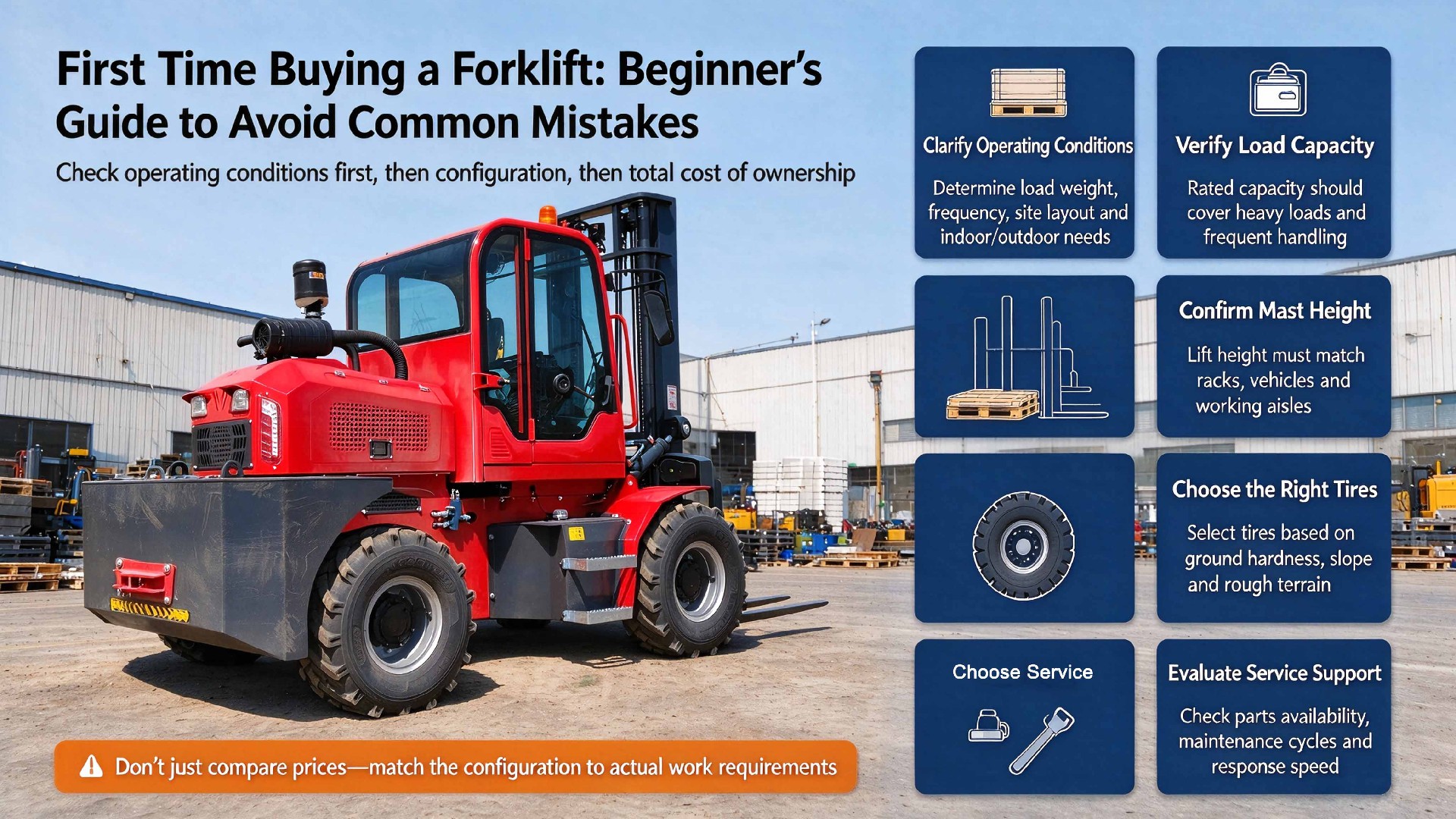
Price matters, but the cheapest forklift may not be the most cost-effective option over its service life. Differences in configuration, operating conditions, maintenance requirements, and parts availability can affect the overall cost of ownership.
Before requesting a quotation, answer three basic questions:
What is the maximum weight and size of the loads you need to handle?
Will the forklift operate indoors, outdoors, or on uneven ground?
How many hours per day will the machine typically work?
If your work involves outdoor material handling on uneven surfaces, a standard warehouse forklift may not be suitable. You can evaluate a GWZOOM R-Type rear-articulated rough terrain forklift as one possible option, while checking its specifications against your site conditions and steering requirements.
A forklift's rated capacity does not mean it can safely lift the same weight under every operating condition. Load center, lifting height, attachments, and the specific machine configuration can all affect its lifting capacity.
Before purchasing, confirm the maximum load weight, dimensions, and center of gravity. Review the capacity plate and the manufacturer's load-capacity information rather than relying on the model name or nominal tonnage alone.
For applications involving heavier construction materials or industrial loads, compare the available configurations of a GWZOOM H-Type heavy-duty rough terrain forklift. Select a model according to the actual load requirements, and never assume that a heavy-duty designation permits overloading.
A forklift must be able to move, turn, and handle loads safely within your facility. Measure aisle widths, door openings, turning areas, loading zones, and any restrictions around storage racks or workstations before selecting a machine.
For compact outdoor work areas, a GWZOOM S-Type rough terrain forklift may be worth evaluating because of its compact body design. However, a shorter chassis does not automatically mean the forklift can fit every narrow space. Confirm the actual overall dimensions, turning radius, load requirements, and available clearance for the specific model.
If the forklift will travel over mud, gravel, or uneven ground, also consider the drive system, tire type, ground clearance, and braking performance. Four-wheel drive can improve traction in suitable conditions, but it does not eliminate the risks associated with steep slopes, unstable ground, or excessive loads.
The quoted machine price is only one part of your purchasing budget. Depending on the transaction, additional costs may include transportation, loading and unloading, optional equipment, spare parts, routine maintenance, and repairs.
When requesting quotations, confirm:
The exact model, rated capacity, and configuration included in the price.
The engine, tires, attachments, and other optional equipment.
Packaging, delivery time, and transportation costs.
Warranty coverage, spare-parts availability, and after-sales support.
Export documentation, payment terms, and delivery arrangements, where applicable.
Compare quotations on the basis of equivalent specifications and commercial terms. A lower initial price does not necessarily mean a lower total cost of ownership.
After-sales support can affect equipment uptime, especially when a forklift is essential to daily operations. Before placing an order, ask whether the supplier provides operating manuals, maintenance guidance, replacement parts, and clear warranty terms.
For a rough terrain forklift, it is useful to confirm the availability of commonly required maintenance items, such as filters and compatible tires, as well as the process for obtaining technical assistance. For imported equipment, also consider spare-parts delivery times and local repair capabilities.
Avoid relying solely on general promises of excellent service. Where possible, make the warranty period, coverage, parts arrangements, and support responsibilities clear in the written agreement.
Before confirming your order, review the following points:
Maximum load weight, dimensions, and load center are confirmed.
Ground conditions, aisle widths, and turning space have been measured.
Rated capacity, lifting height, and machine dimensions meet your needs.
Model configuration and optional equipment are clearly specified.
Delivery schedule, transportation costs, and payment terms are confirmed.
Warranty coverage, maintenance requirements, and parts availability are understood.
The final order matches the agreed model and technical specifications.
Your first forklift does not need to have the most features. It needs to perform your daily tasks reliably and safely. By defining your requirements before comparing prices, you can reduce the risk of choosing an unsuitable machine and avoid unexpected costs later.
Q1: What should I consider first when buying a forklift?
A: Start with your load weight, load dimensions, working environment, lifting requirements, and daily workload. Then compare suitable models and quotations.
Q2: Is a forklift with a higher rated capacity always better?
A: No. The rated capacity should match your actual loads and operating conditions. An unnecessarily large machine may increase purchase and operating costs without providing practical benefits.
Q3: What type of forklift is suitable for outdoor work?
A: Evaluate the ground conditions, drive system, tires, ground clearance, steering, and braking performance. A rough terrain forklift may be suitable for uneven outdoor surfaces, but the specific model must match the site requirements.
Q4: What costs should I check beyond the forklift price?
A: Consider optional equipment, transportation, delivery, maintenance, spare parts, and the terms of warranty and after-sales service.
Q5: What information should I provide when requesting a forklift quotation?
A: Provide the load weight and dimensions, working environment, required lifting height, expected workload, order quantity, and delivery location. These details help the supplier recommend a suitable configuration.
WhatsApp: +86 130 5355 7263
Phone:+86 130 5355 7263
Email: info@allterrainforklift.cn
Add:Shahe Town Industrial Park, Laizhou City, Shandong Province
We chat