Email: info@allterrainforklift.cn WhatsApp: +86 13053557263
Language:  ∷
∷ 
∷  ∷
∷ 
Time:2026-10-04 10:00:00 Read:0
Rough terrain forklift tires are different from regular forklift tires mainly because they work in different environments. Regular forklifts are typically used on smooth, hard surfaces in warehouses and factories, while a rough terrain forklift may operate on mud, gravel, uneven ground, slopes, and other outdoor surfaces. Its tires therefore need to provide suitable traction, durability, and load support for changing ground conditions.
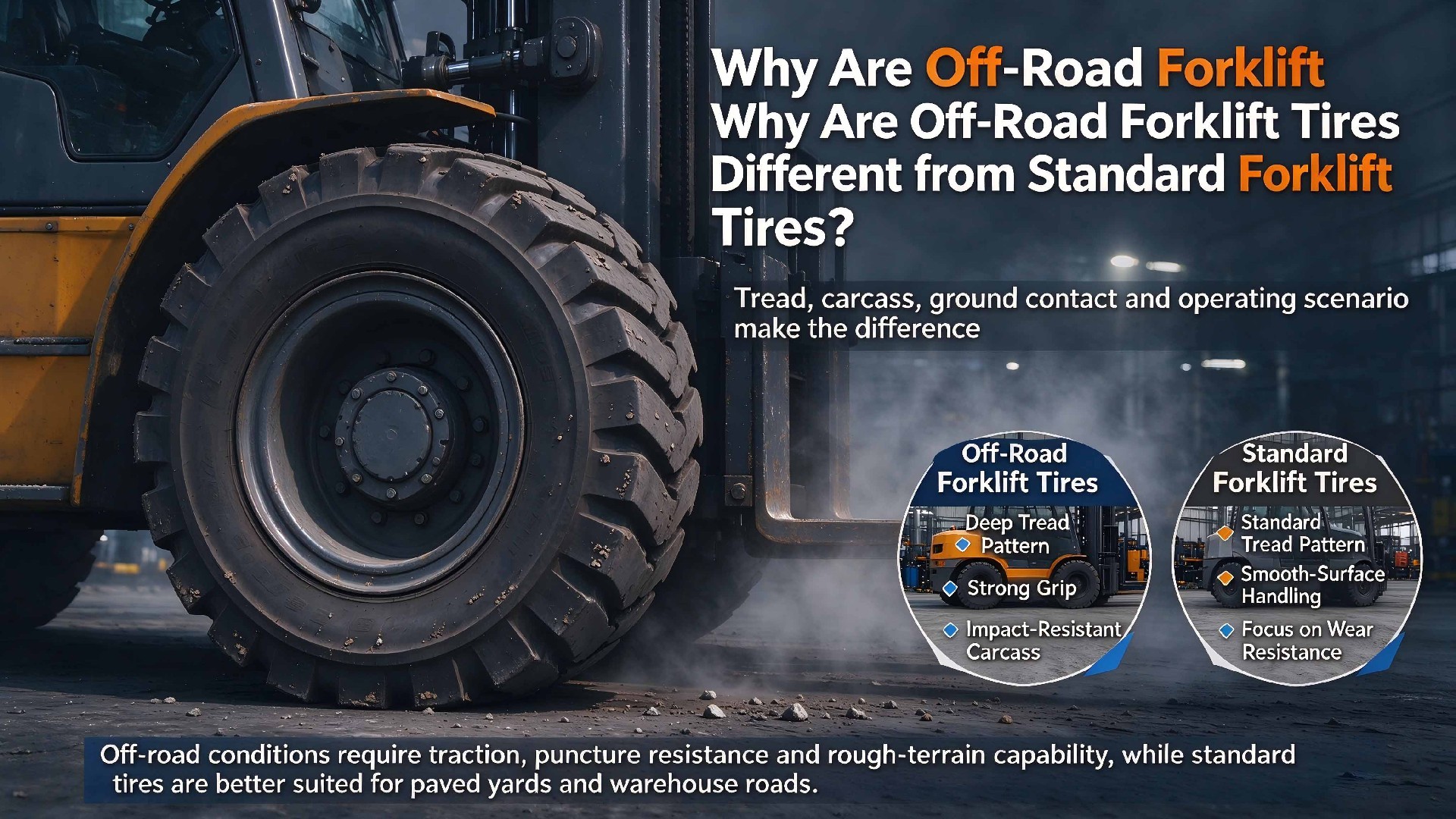
Regular forklift tires are designed mainly for relatively flat and stable surfaces. Their key requirements include load support, stability, and easy steering during routine material handling.
A rough terrain forklift, however, may need to travel across loose soil, gravel, potholes, or uneven construction sites. Under these conditions, the contact between the tire and the ground can directly affect traction and vehicle stability.
That is why rough terrain forklift tires are designed and selected with outdoor operating conditions in mind. The difference is not simply about tire size or tread pattern. The tires also need to match the forklift's load capacity, drivetrain, and working environment.
Traction becomes especially important when a forklift works on mud, gravel, or sloped ground. Insufficient traction can cause wheel slip and make it more difficult for the forklift to move and handle materials effectively.
This is also why 4WD rough terrain forklift tires should not be considered separately from the forklift's drivetrain. The 4WD system delivers power to the wheels, while the tires transfer that power to the ground. Both need to work together for the intended operating conditions.
For applications where outdoor operation is combined with limited working space, an S-Type short rough terrain forklift can be considered. Its compact design is intended to reduce the space required for operation while retaining the characteristics of an articulated rough terrain forklift.
A rough terrain forklift does more than travel across uneven ground. It also needs to lift and transport loads while operating outdoors. Therefore, when considering rough terrain forklift tire features, load capacity and operating frequency are also important.
For general outdoor material handling, the tire configuration should be matched with the forklift's capacity and actual working conditions. A C-Type integrated standard rough terrain forklift can be considered when the application requires an integrated machine design for outdoor material handling.
For more demanding engineering applications, an E-Type integrated engineering rough terrain forklift provides another configuration to consider. The choice should still be based on the actual load, ground conditions, tire specifications, and operating requirements rather than on the tire alone.
So, how to choose rough terrain forklift tires? Start with the actual working conditions:
Check the ground: Is the forklift operating on mud, gravel, hard surfaces, or a combination of different surfaces?
Check the load: The expected load determines the required vehicle capacity and tire load requirements.
Check operating frequency: Frequent outdoor operation places greater demands on tire durability.
Check the forklift configuration: Tires should be compatible with the forklift's drivetrain, structure, capacity, and intended application.
If you are still comparing configurations, the rough terrain forklift product range can be used as a starting point before matching the machine to the actual jobsite.
In short, why are rough terrain forklift tires different? Because the working environment is different. The right tire is not simply the largest tire or the one with the deepest tread. Tire selection works best when the tire, drivetrain, forklift structure, and operating conditions are considered together.
Q1: Can a rough terrain forklift use regular forklift tires?
It depends on the specific forklift model and manufacturer configuration. Tires should not be replaced based on size alone.
Q2: What are the main features of rough terrain forklift tires?
They are selected to provide suitable traction, durability, load support, and performance for outdoor and uneven working conditions.
Q3: How should I choose tires for a 4WD rough terrain forklift?
Consider the forklift capacity, drivetrain, tire specifications, ground conditions, and actual workload together.
Q4: Where are rough terrain forklifts commonly used?
Common applications include construction sites, farms, ranches, and other outdoor material handling environments.
Q5: Are larger tires or deeper treads always better?
Not necessarily. Tire specifications need to match the forklift and its operating conditions. A larger tire or deeper tread alone does not guarantee better performance.
WhatsApp: +86 130 5355 7263
Phone:+86 130 5355 7263
Email: info@allterrainforklift.cn
Add:Shahe Town Industrial Park, Laizhou City, Shandong Province
We chat