Email: info@allterrainforklift.cn WhatsApp: +86 13053557263
Language:  ∷
∷ 
∷  ∷
∷ 
Time:2026-09-24 16:35:48 Read:1
The main difference between part-time 4WD and full-time 4WD is how four-wheel drive is engaged during operation. Part-time 4WD allows the operator to switch between two-wheel drive and four-wheel drive according to working conditions, while full-time 4WD continuously drives all four wheels. For a 4WD forklift, the right system depends on the terrain, load, slope, and frequency of 4WD operation.
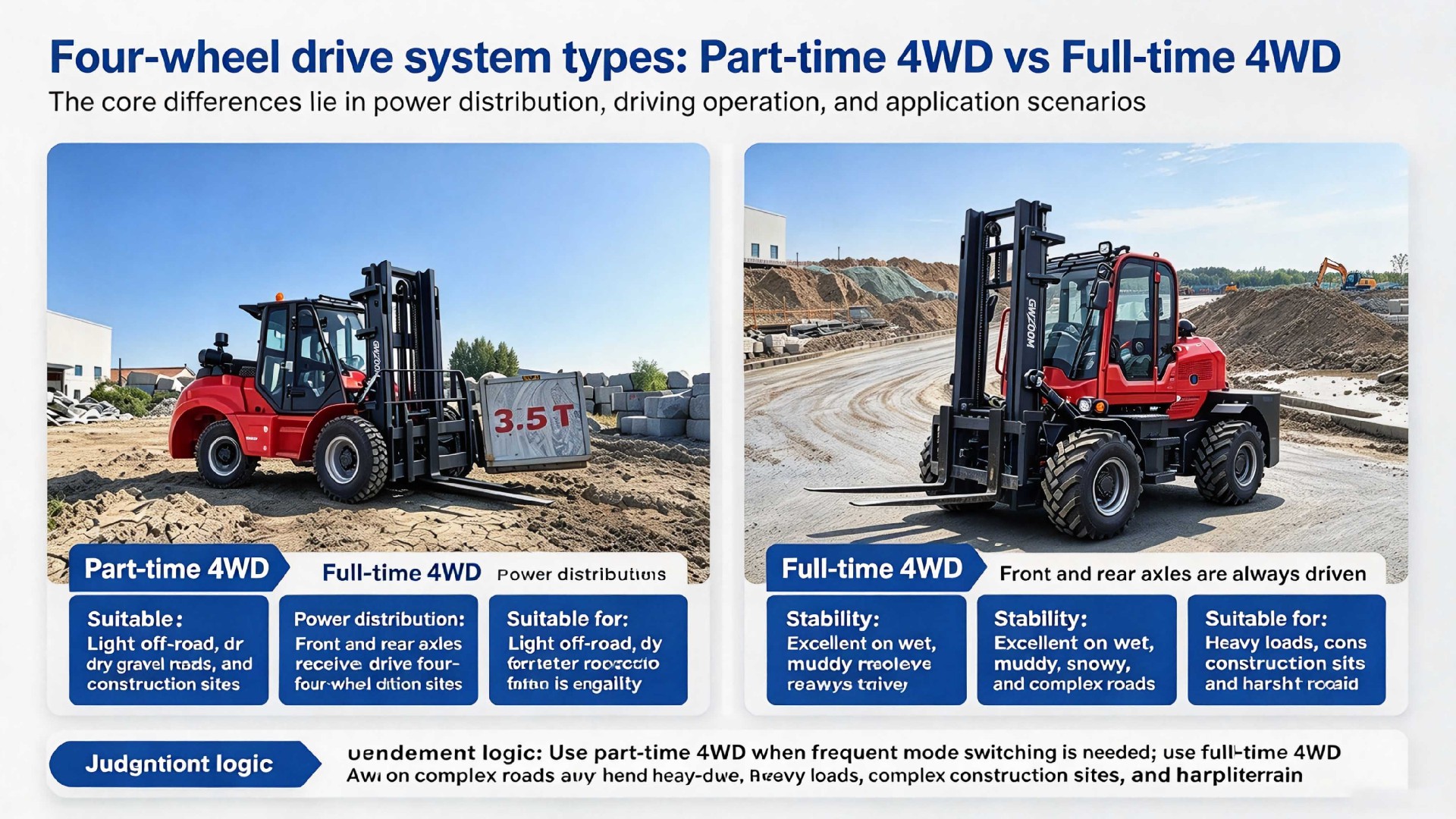
Part-time 4WD allows the vehicle to operate in two-wheel drive under normal conditions and engage four-wheel drive when additional traction is needed.
On firm, level surfaces, two-wheel drive may be sufficient for routine material handling. When the forklift enters mud, gravel, slopes, or uneven terrain, four-wheel drive can be engaged to provide additional traction.
This makes part-time 4WD for rough terrain suitable for applications where working conditions change between paved and challenging surfaces.
Full-time 4WD continuously sends driving force to all four wheels while the vehicle is operating.
The main advantage is that the operator does not need to switch between two-wheel drive and four-wheel drive when working conditions change. This can be useful when a forklift spends most of its working time on uneven ground, slopes, gravel, or other demanding outdoor surfaces.
Therefore, full-time 4WD for outdoor applications can be considered when consistent four-wheel-drive capability is required throughout the working cycle.
Understanding the difference between part-time and full-time 4WD is easier when looking at how each system is used:
| Feature | Part-time 4WD | Full-time 4WD |
|---|---|---|
| 4WD operation | Engaged when needed | Continuously active |
| Normal flat surfaces | Can use 2WD | Remains in 4WD |
| Rough terrain | Switch to 4WD | Continuous 4WD |
| Operator input | Requires mode selection | Less frequent switching |
| Typical application | Changing ground conditions | Consistently demanding terrain |
Neither system is automatically suitable for every application. The choice should be based on how and where the forklift will actually operate.
When selecting a 4WD forklift drivetrain, start with the working environment.
Does the ground change frequently?
If a forklift moves between paved areas and rough outdoor surfaces, the flexibility of part-time 4WD may be relevant.
Does the forklift constantly operate outdoors?
For equipment that spends most of its working time on gravel, mud, slopes, or uneven ground, continuous four-wheel-drive capability may be more important.
Are heavy loads or slopes involved?
Heavy loads and uphill operation increase the demand for traction. The drivetrain should therefore be considered together with rated capacity, engine output, tires, and chassis design.
How often is 4WD actually needed?
If four-wheel drive is only occasionally required, a system that allows the operator to engage it when necessary may be sufficient. If 4WD is needed throughout most of the working cycle, continuous four-wheel-drive operation becomes more relevant.
A 4WD system for rough terrain forklifts is only one part of overall vehicle performance. Engine output, transmission, tires, chassis, steering, and rated capacity must also match the application.
GWZOOM offers different rough terrain forklift configurations for outdoor material handling. A rear articulated rough terrain forklift can be considered for applications requiring maneuverability, while a heavy-duty rough terrain forklift is available for applications with higher load requirements. For engineering-oriented outdoor work, an integrated engineering rough terrain forklift can be considered.
The right choice starts with the actual working conditions rather than simply choosing between two 4WD system types.
Q1: What is the difference between part-time and full-time 4WD?
A: Part-time 4WD allows the operator to engage four-wheel drive when needed, while full-time 4WD continuously drives all four wheels.
Q2: Is part-time 4WD suitable for rough terrain forklifts?
A: It can be suitable when the forklift operates on both firm surfaces and rough terrain and does not require 4WD throughout the entire working cycle.
Q3: When is full-time 4WD useful?
A: It can be useful when a forklift continuously operates on uneven ground, slopes, gravel, mud, or other demanding outdoor surfaces.
Q4: Does full-time 4WD always provide better performance?
A: Not necessarily. The appropriate system depends on the working environment, operating pattern, load, and how frequently four-wheel drive is required.
Q5: What else should I consider when choosing a 4WD forklift?
A: Consider load capacity, engine output, tires, chassis design, steering, ground conditions, slopes, and expected operating hours in addition to the 4WD system.
WhatsApp: +86 130 5355 7263
Phone:+86 130 5355 7263
Email: info@allterrainforklift.cn
Add:Shahe Town Industrial Park, Laizhou City, Shandong Province