Email: info@allterrainforklift.cn WhatsApp: +86 13053557263
Language:  ∷
∷ 
∷  ∷
∷ 
Time:2026-09-25 10:00:00 Read:0
4WD forklifts improve traction and mobility on uneven mine roads, but four-wheel drive alone does not guarantee safe ramp operations. On mine slopes, safety also depends on load stability, driving speed, braking performance, ground conditions, and correct operating procedures.
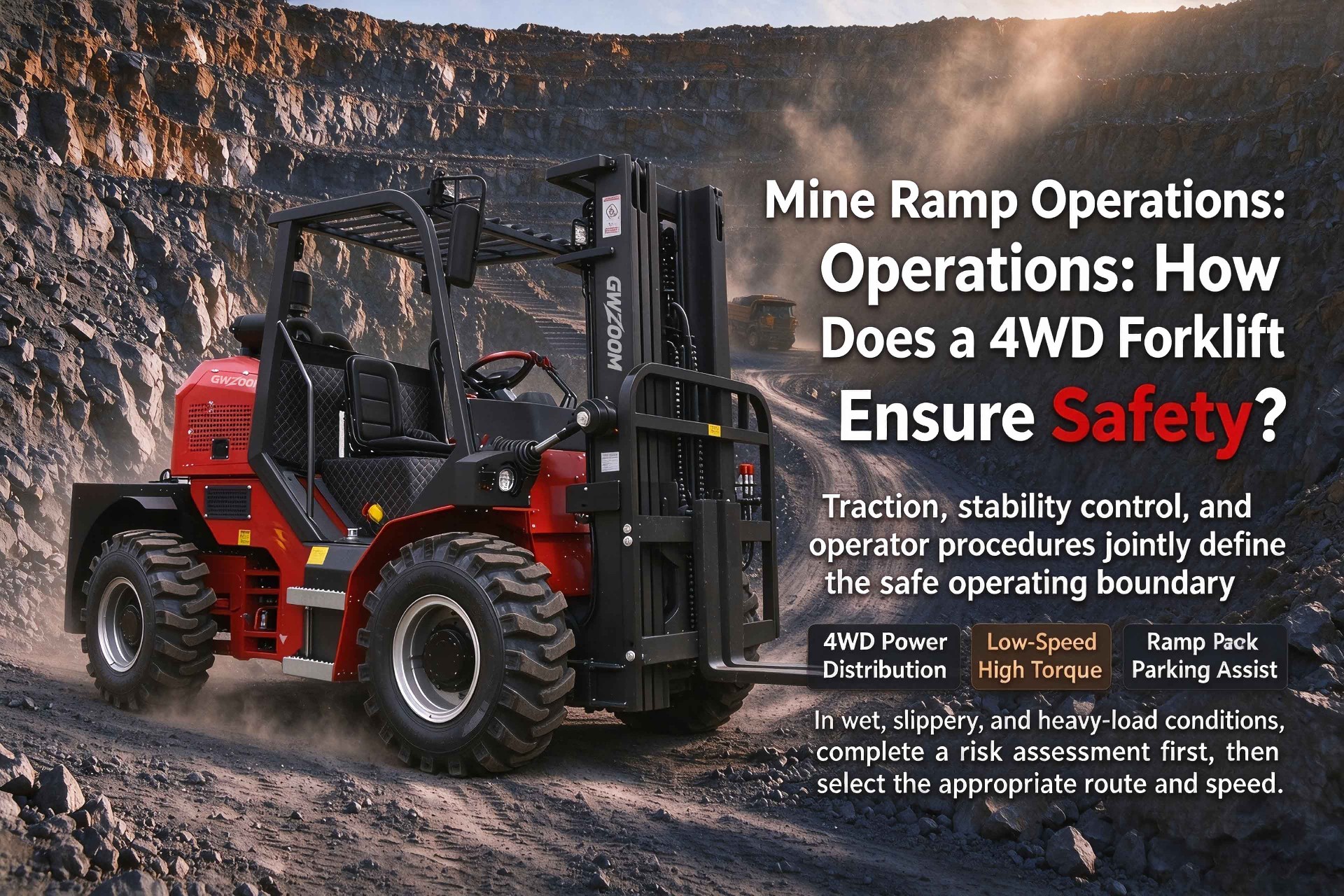
Mine roads often include loose gravel, uneven surfaces, wet ground, and changing slopes. A 4WD forklift for mine ramp operations can distribute driving force across four wheels, helping maintain traction when compared with a forklift designed for more controlled surfaces.
However, operators should never treat 4WD as a substitute for proper operating limits. OSHA guidance states that rough-terrain forklifts should be used where conditions require them, loads should remain within rated capacity, and grades should be ascended and descended slowly.
A stable load is essential when working on an incline. The load should remain within the forklift's rated capacity and be positioned securely. On steep grades, operating procedures should follow the manufacturer's instructions and applicable local safety requirements.
Speed should be adjusted to the slope, surface and load. Sudden acceleration, braking or turning can reduce stability, especially on loose or uneven ground. OSHA recommends slow travel when ascending or descending grades.
A mine ramp should be strong enough to support the forklift, load and operator. Potholes, loose material, mud, oil and other obstructions can increase the risk of skidding or loss of control.
A rough terrain forklift for mining should match the actual working conditions, including load requirements, ramp conditions and available operating space.
For example, a rear-articulated rough terrain forklift can be considered where maneuverability on changing terrain is important. A short rough terrain forklift can be useful when mine-site working areas are relatively restricted. For heavier material-handling requirements, buyers can also review the heavy-duty rough terrain forklift range.
4WD provides an important traction advantage, but it is only one part of the safety system. 4WD forklift traction on slopes must work together with appropriate capacity, stable loads, controlled speed, suitable braking, proper ground conditions and trained operators.
Before purchasing a mining forklift, buyers should evaluate the actual ramp gradient, surface conditions, typical load weight, operating frequency and required maneuverability. This helps ensure that the forklift is matched to the mine environment rather than relying on 4WD alone.
Q1: Is a 4WD forklift suitable for mine ramps?
A: It can be suitable for rough and uneven mine environments when its specifications match the site conditions and operating requirements.
Q2: Does 4WD prevent a forklift from tipping over on a slope?
A: No. 4WD can improve traction, but stability still depends on load, slope, speed, ground conditions and correct operation.
Q3: How should a forklift operate on a mine ramp?
A: Operators should travel at a controlled speed, keep loads stable and within rated capacity, inspect the route, and follow the manufacturer's operating instructions.
Q4: What should buyers consider when selecting a mining forklift?
A: Consider load capacity, ramp conditions, ground surface, required traction, maneuverability, braking performance and the frequency of slope operations.
WhatsApp: +86 130 5355 7263
Phone:+86 130 5355 7263
Email: info@allterrainforklift.cn
Add:Shahe Town Industrial Park, Laizhou City, Shandong Province