Email: info@allterrainforklift.cn WhatsApp: +86 13053557263
Language:  ∷
∷ 
∷  ∷
∷ 
Time:2026-09-21 17:22:20 Read:1
A 4WD forklift usually costs more than a 2WD forklift because of its additional drivetrain, transmission, and chassis configuration. Whether the extra cost is worthwhile depends largely on the working environment, load weight, slopes, and how frequently the forklift operates outdoors.
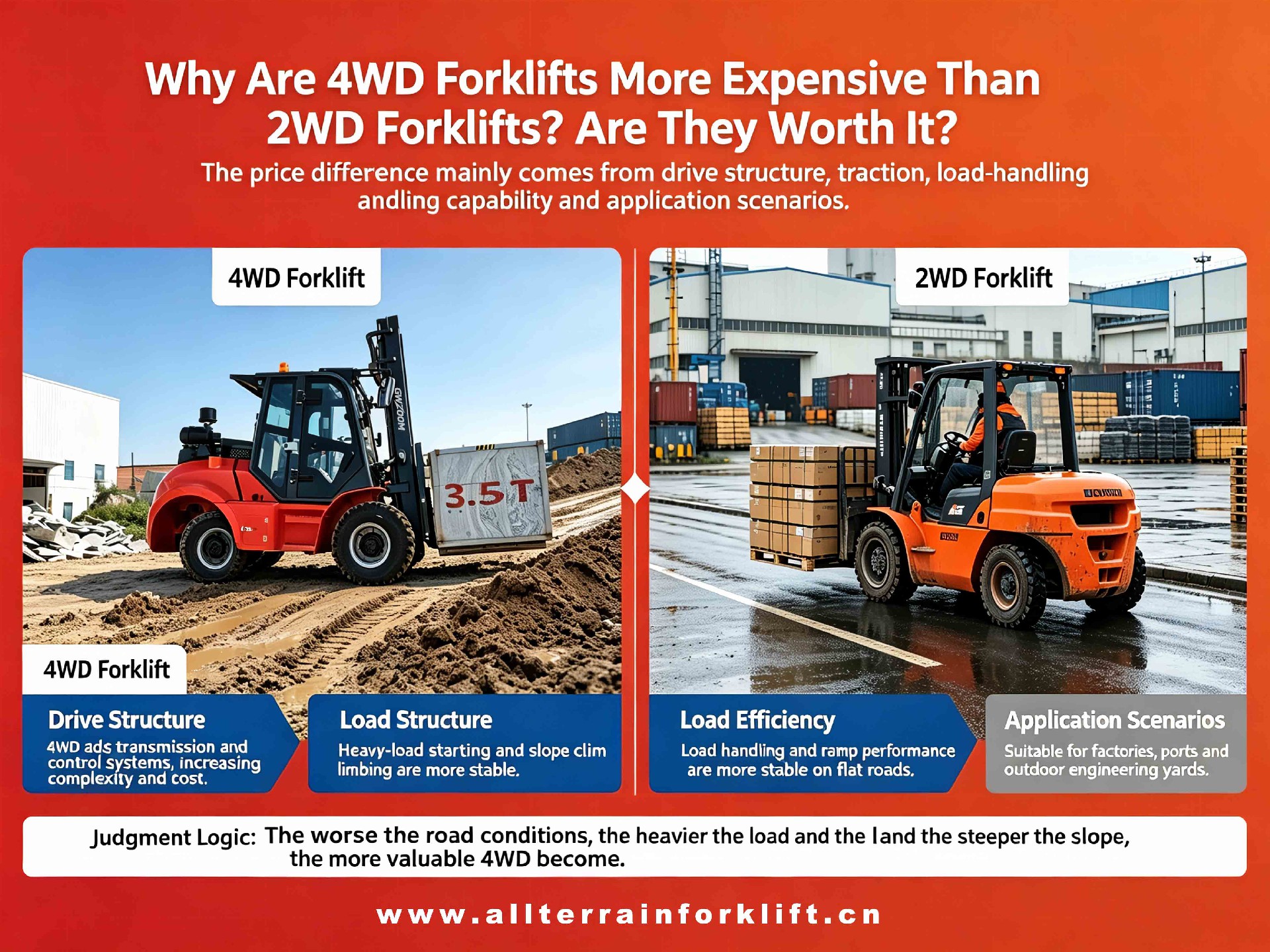
The most obvious difference between a 4WD and 2WD forklift is the way driving force is delivered to the wheels.
A 2WD forklift relies mainly on two driven wheels and is well suited to flat, paved surfaces. A 4WD forklift uses all four wheels to deliver driving force, requiring additional drivetrain components and a compatible chassis design.
For rough terrain applications, the vehicle may also require tires and other components designed for outdoor conditions. These factors contribute to the 4WD rough terrain forklift price difference.
In other words, the additional cost is not simply for having four driven wheels. It reflects the extra equipment needed to improve traction and mobility in demanding working environments.
On smooth and level surfaces, a 2WD forklift can handle many routine material-handling tasks effectively. The difference becomes more noticeable when the forklift operates on gravel, mud, slopes, or uneven ground.
This is where 4WD forklift traction becomes particularly relevant.
When carrying a heavy load, a forklift needs sufficient driving force to start, climb, and maneuver. If the ground provides limited traction, the ability to transfer engine power to the ground becomes increasingly important.
Therefore, when comparing 4WD vs 2WD forklifts, purchase price should not be the only consideration. The actual working environment matters just as much.
A 4WD forklift can be particularly useful in several situations.
1. Unpaved or uneven surfaces
Construction sites, farms, yards, and outdoor storage areas may have gravel, soil, mud, or uneven surfaces. These conditions place greater demands on forklift traction and mobility.
2. Sloped working areas
Moving heavy loads on slopes requires consistent driving force. If a forklift frequently travels uphill or downhill, drivetrain capability becomes an important consideration.
3. Heavy outdoor loads
As load weight increases, more driving force may be required during starting, climbing, and maneuvering. The benefit of 4WD can become more noticeable when heavy loads are combined with challenging ground conditions.
4. Frequent outdoor operation
If a forklift only occasionally leaves a warehouse, the additional 4WD capability may not be fully utilized. However, when outdoor work is a major part of daily operations, traction and terrain capability become more important purchasing factors.
A 2WD forklift may be sufficient when the equipment is mainly used in warehouses, factories, or other paved and level areas.
If there are few slopes, limited outdoor transportation, and stable ground conditions, buyers may place greater emphasis on factors such as rated capacity, lifting height, overall dimensions, turning radius, and maintenance requirements.
So, is a 4WD forklift worth it? There is no universal answer. The right choice depends on whether the additional capability solves a real problem in the intended working environment.
For customers handling materials outdoors, GWZOOM offers different 4WD rough terrain forklift configurations for different operating requirements.
A front articulated rough terrain forklift can be considered when maneuverability and outdoor handling are important. A short rough terrain forklift offers a more compact configuration for space-limited working areas. An integrated standard rough terrain forklift can be considered when customers need a compact machine with flexible operation.
The key is to evaluate what the forklift actually needs to handle rather than simply comparing the purchase prices of 2WD and 4WD models.
Explore the front articulated rough terrain forklift, short rough terrain forklift, and integrated rough terrain forklift options for different outdoor material-handling requirements.
For more information, visit the GWZOOM official website.
Q1: Why does a 4WD forklift cost more than a 2WD forklift?
A: A 4WD forklift requires additional drivetrain and related chassis components. Rough terrain models may also use configurations designed for demanding outdoor conditions.
Q2: Is a 4WD forklift always better than a 2WD forklift?
A: Not necessarily. A 2WD forklift can be suitable for many flat and paved applications, while 4WD becomes more relevant when traction and terrain capability are required.
Q3: What applications are suitable for a 4WD forklift?
A: Typical applications include construction sites, farms, outdoor yards, gravel surfaces, slopes, and other environments where ground conditions are more demanding.
Q4: When is a 2WD forklift a practical choice?
A: A 2WD forklift can be suitable for warehouses, factories, and other locations with stable, level, and paved working surfaces.
Q5: What should I consider before buying a 4WD forklift?
A: Consider load weight, ground conditions, slopes, operating hours, working space, traction requirements, and the frequency of outdoor operation.
WhatsApp: +86 130 5355 7263
Phone:+86 130 5355 7263
Email: info@allterrainforklift.cn
Add:Shahe Town Industrial Park, Laizhou City, Shandong Province