Email: info@allterrainforklift.cn WhatsApp: +86 13053557263
Language:  ∷
∷ 
∷  ∷
∷ 
Time:2026-10-08 17:45:43 Read:0
The best forklift tires for muddy job sites are not simply the deepest tires available. In muddy construction environments, tire performance depends on tread pattern, load capacity, drivetrain, and ground conditions. Herringbone tread, block tread, and deep-groove off-road tires are common options for rough terrain forklifts, but the right choice should match the actual job site rather than appearance alone.
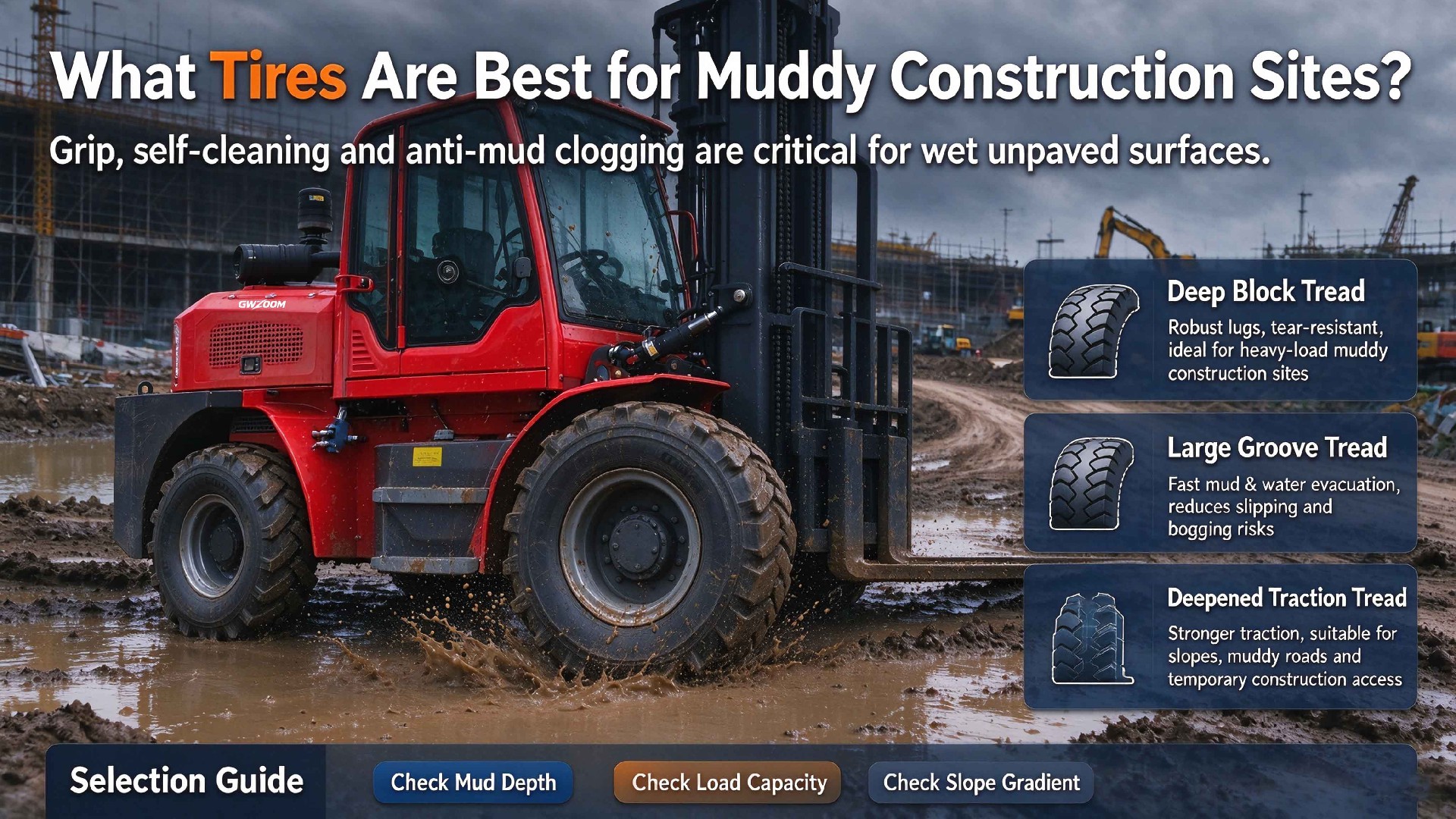
Mud changes the way a tire contacts the ground. Soft soil, standing water, clay, and uneven surfaces can reduce traction and make material handling more difficult.
A forklift carrying heavy loads places additional pressure on the ground. If the tires cannot provide enough grip or clear mud effectively, wheel slip may occur and productivity can be reduced.
This is why rough terrain forklift tires are designed differently from standard warehouse forklift tires. Tire selection should always consider the surface conditions, expected loads, and operating frequency.
Herringbone tread features V-shaped grooves across the tire surface. This pattern is commonly associated with off-road applications because it can help improve traction on soft soil, muddy areas, and sloped ground.
For construction sites where forklifts frequently move between compacted roads and muddy sections, herringbone-style tires can be one option to consider.
When maneuverability is important in uneven outdoor conditions, buyers may also compare machine designs such as the F-Type front-articulated rough terrain forklift. Tire choice and vehicle structure should be evaluated together rather than separately.
Block tread tires use separate tread blocks with larger grooves between them. Depending on the design, this type of tread can provide traction while helping mud and debris leave the tread surface.
Many muddy construction sites also include gravel roads, crushed stone, and uneven ground. In these conditions, buyers often need a balance between traction and durability.
For applications that require good stability across different outdoor surfaces, the R-Type rear-articulated rough terrain forklift can be considered together with suitable tire specifications and load requirements.
Tire selection should never focus only on tread design.
A forklift working in muddy conditions still needs to carry heavy materials safely. Tire size, load rating, inflation pressure, and machine capacity all affect overall performance.
For demanding construction applications involving steel, concrete, timber, or other heavy materials, buyers may also evaluate the H-Type heavy-duty rough terrain forklift. The tire specification should always match the forklift's rated capacity and working conditions.
Even the best tire cannot perform effectively without an appropriate drivetrain.
A 4WD rough terrain forklift distributes power to all wheels, helping improve mobility on muddy and uneven surfaces. However, traction still depends on the combination of:
Tire tread pattern
Ground conditions
Vehicle weight
Load size
Tire pressure
Driving system
This is why rough terrain forklift tire selection should consider the complete machine rather than the tire alone.
If you are comparing different configurations, the rough terrain forklift product range provides an overview of available models for various job sites.
Not necessarily.
Deep tread and large grooves may perform well in wet soil or clay, but if the forklift spends part of its time on compacted roads or hard surfaces, an extremely aggressive tread may not provide the best overall balance.
The best approach is to match the tire to:
Type of mud or soil
Load weight
Surface changes
Working hours
Forklift configuration
Ultimately, the best forklift tires for muddy job sites are the ones that match the ground conditions, load requirements, and machine design—not simply the tires with the deepest tread.
Q1: What tread pattern is best for muddy job sites?
Herringbone tread and certain block tread designs are commonly considered for muddy conditions, but the best choice depends on soil type, load, and forklift specifications.
Q2: Are rough terrain forklift tires different from warehouse forklift tires?
Yes. Rough terrain forklift tires are selected for outdoor surfaces such as mud, gravel, and uneven ground.
Q3: Do muddy job sites always require 4WD forklifts?
Not always, but 4WD systems are often preferred where traction and mobility are important.
Q4: Is deeper tread always better?
No. Tread depth should match the actual surface conditions and operating environment.
Q5: What should I consider before selecting forklift tires?
Check tread pattern, load rating, tire size, ground conditions, forklift capacity, and drivetrain compatibility.
WhatsApp: +86 130 5355 7263
Phone:+86 130 5355 7263
Email: info@allterrainforklift.cn
Add:Shahe Town Industrial Park, Laizhou City, Shandong Province
We chat