Email: info@allterrainforklift.cn WhatsApp: +86 13053557263
Language:  ∷
∷ 
∷  ∷
∷ 
Time:2026-09-16 16:34:52 Read:1
Choosing a diesel forklift is not simply about looking at engine horsepower. Diesel forklift engine specifications such as power, torque, displacement, rated speed, and fuel consumption all affect how the forklift performs under different working conditions. Understanding these parameters helps buyers match the engine with the required load and application.
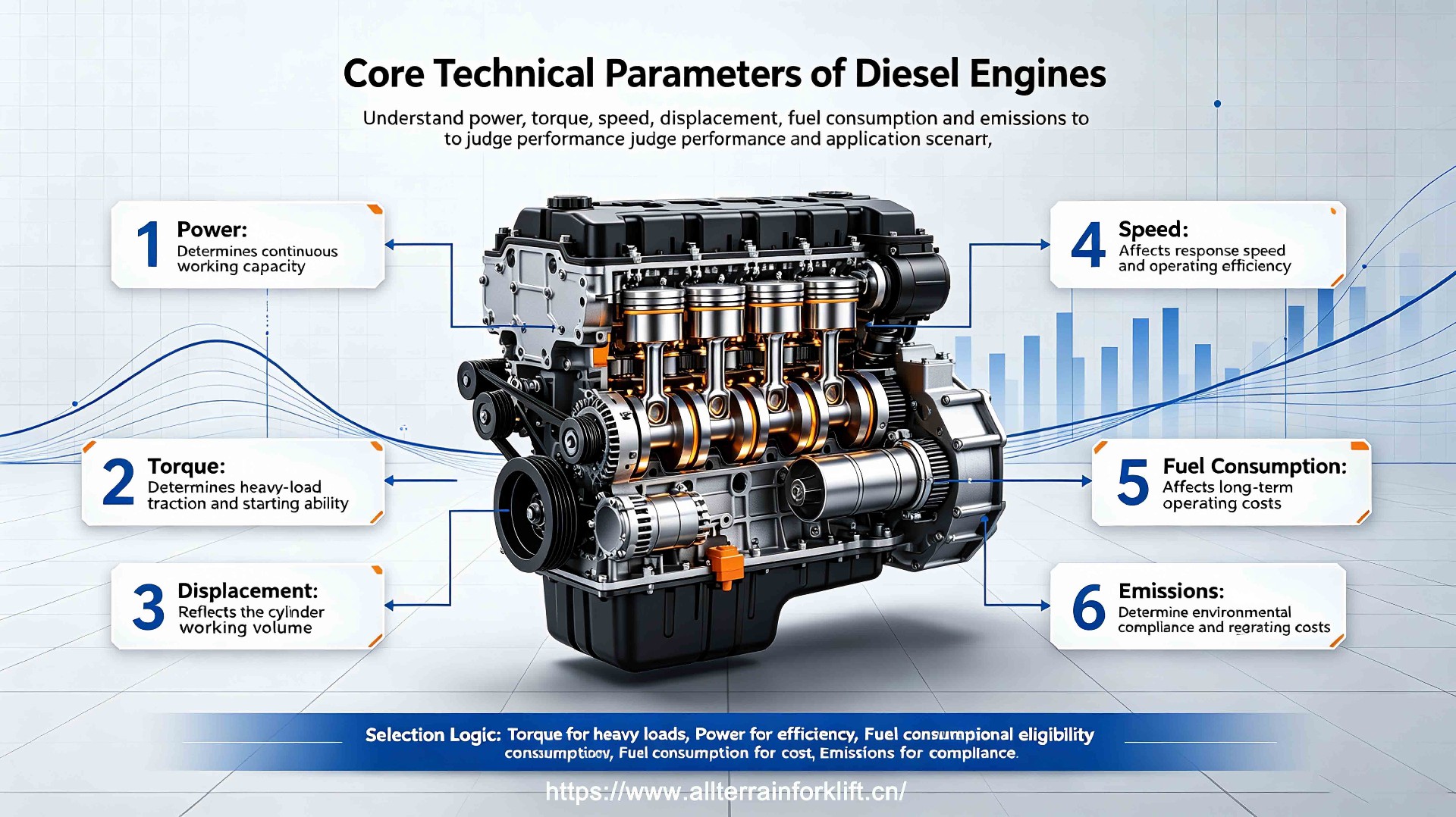
Engine power is usually measured in kW and indicates the engine's ability to perform work.
For a forklift, higher power can support demanding operations such as heavy-load handling, frequent acceleration, and operation on slopes. However, maximum power alone does not determine whether an engine is suitable.
When comparing diesel forklift engine power, buyers should consider the forklift's rated capacity, operating weight, transmission, and intended working environment.
Torque, normally measured in N·m, represents the engine's rotational force.
For forklifts, torque is particularly important during low-speed operation, loaded starts, climbing, and repeated handling cycles. A suitable torque output helps the forklift maintain stable driving performance when carrying heavy loads.
When checking diesel forklift engine torque, it is useful to look at both the maximum torque and the engine speed at which it is produced.
Engine displacement, measured in liters (L), refers to the total swept volume of the engine's cylinders.
Displacement can influence an engine's power and torque characteristics, but a larger engine does not automatically mean better performance. Fuel system design, engine configuration, and tuning also affect the final output.
Therefore, diesel forklift engine displacement should be evaluated together with power, torque, and operating requirements.
Rated speed is generally expressed in r/min and refers to the engine speed associated with its rated power.
A forklift does not operate continuously at maximum engine speed. In real applications, stable performance within the commonly used operating range is often more relevant.
For this reason, buyers should compare rated power, maximum torque, and their corresponding engine speeds rather than looking at one number independently.
Fuel consumption is an important consideration for forklifts used for many hours every day.
Actual fuel consumption depends on factors such as load, operating speed, working cycle, terrain, and driving habits. Therefore, a single published fuel-consumption figure cannot represent every application.
For businesses operating forklifts for extended periods, a properly matched diesel engine can help maintain productivity while controlling operating costs.
So, how to choose a diesel forklift engine for a specific application?
Start with the working conditions:
Regular light or medium loads: focus on balanced power and fuel efficiency.
Frequent heavy-load handling: pay closer attention to torque and continuous power output.
Outdoor or uneven terrain: consider engine performance together with drivetrain and chassis capability.
Long working hours: evaluate fuel consumption and overall equipment reliability as well as engine output.
The engine is only one part of a forklift's performance. Transmission, drivetrain, tires, steering, and overall vehicle design also influence the final working capability.
For outdoor material handling, choosing the right engine requires more than comparing numbers on a specification sheet. The engine should match the forklift's capacity and the actual working environment.
GWZOOM provides 4WD rough terrain forklift solutions for construction, agriculture, and other outdoor material-handling applications. Depending on the working scenario, buyers can explore options such as the rear articulated rough terrain forklift and integrated rough terrain forklift to compare different configurations.
For more product information, visit the GWZOOM official website.
Q1: What are the key diesel forklift engine specifications?
A: The main specifications include engine power, torque, displacement, rated speed, and fuel consumption.
Q2: Is higher engine power always better for a forklift?
A: Not necessarily. Engine power should be matched with the forklift's rated capacity, drivetrain, and working conditions.
Q3: Why is engine torque important for diesel forklifts?
A: Torque affects loaded starts, low-speed operation, climbing, and the ability to maintain driving force under heavy loads.
Q4: Does larger engine displacement mean better forklift performance?
A: Not automatically. Displacement should be considered together with power, torque, engine design, and the intended application.
Q5: What should I consider besides the engine?
A: Buyers should also evaluate the drivetrain, transmission, tires, steering system, chassis design, load capacity, and actual operating environment.
WhatsApp: +86 130 5355 7263
Phone:+86 130 5355 7263
Email: info@allterrainforklift.cn
Add:Shahe Town Industrial Park, Laizhou City, Shandong Province