Email: info@allterrainforklift.cn WhatsApp: +86 13053557263
Language:  ∷
∷ 
∷  ∷
∷ 
Time:2026-09-20 10:18:28 Read:1
Ports and docks handle heavy materials for long hours, often in demanding outdoor environments. For these applications, a diesel forklift can provide the continuous power, load-handling capability, and outdoor adaptability required for demanding material handling operations.
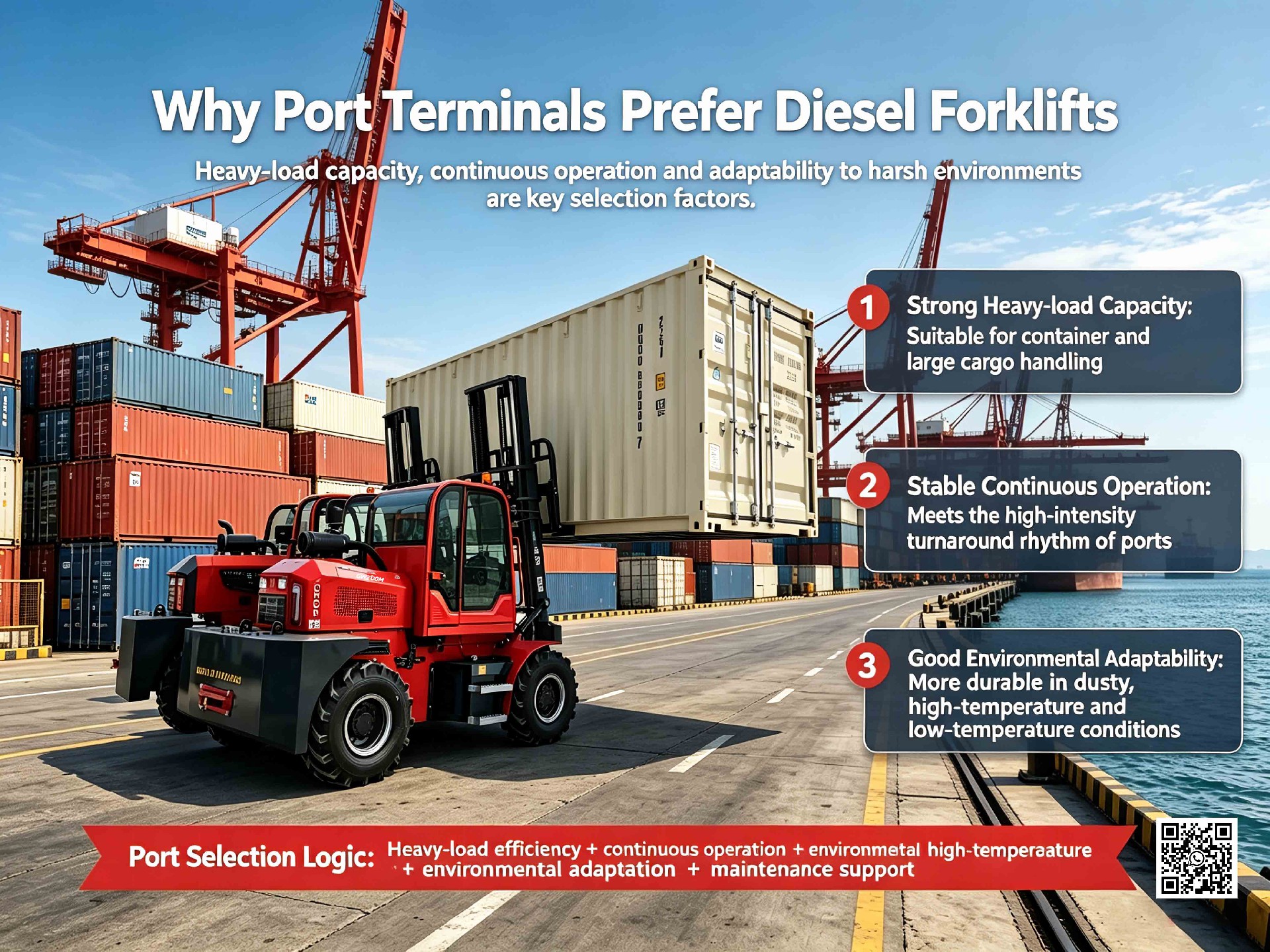
Port operations may involve steel products, pallets, machinery components, timber, and other heavy materials. Forklifts need to lift these loads while also maintaining stable performance during starting, turning, and transportation.
When selecting a port forklift, operators typically consider engine power, torque, rated capacity, and overall vehicle performance. Diesel-powered forklifts can provide consistent power for demanding load-handling cycles.
Material handling at ports and docks can continue for extended periods. Loading, unloading, transferring, and positioning cargo may require forklifts to operate repeatedly throughout the working day.
For these applications, equipment needs more than short-term performance. A properly matched diesel forklift can provide reliable power for continuous outdoor operations, while its established mechanical design also supports routine maintenance.
Ports and docks are primarily outdoor working environments. Depending on the site, forklifts may operate on concrete yards, paved surfaces, gravel areas, or other uneven ground.
This means choosing a diesel forklift for port operations should involve more than comparing engine specifications. Tires, chassis design, steering, drivetrain, and ground clearance can all affect how the forklift performs in real working conditions.
For sites with uneven or challenging surfaces, a 4WD rough terrain forklift can provide an alternative solution for outdoor material handling.
When selecting a forklift for port and dock operations, consider several factors:
Load capacity: Determine the maximum weight that needs to be handled.
Operating hours: Consider how frequently and how long the forklift will work each day.
Ground conditions: Check whether the site has uneven, gravel, muddy, or other challenging surfaces.
Working space: Choose a suitable steering and chassis configuration for the available space.
Maintenance: Consider the accessibility and practicality of routine service.
The right choice is therefore not simply about choosing diesel power. The engine, drivetrain, load capacity, tires, and overall vehicle configuration should match the actual application.
For ports, docks, and other outdoor material-handling environments, GWZOOM offers different 4WD rough terrain forklift configurations.
A rear articulated rough terrain forklift can provide maneuverability for outdoor handling applications. An integrated engineering rough terrain forklift is designed as a compact, integrated solution for demanding work environments, while a heavy-duty rough terrain forklift can be considered when higher load capacity is required.
The appropriate configuration depends on cargo weight, ground conditions, working space, and operating intensity.
Explore the rear articulated rough terrain forklift, integrated rough terrain forklift, and heavy-duty rough terrain forklift options to compare different solutions.
For more information about GWZOOM's rough terrain forklift solutions, visit the GWZOOM official website.
Q1: Why do ports often use diesel forklifts?
A: Ports require heavy-load handling, long operating hours, and outdoor operation. Diesel forklifts can provide stable power for these demanding applications.
Q2: Are diesel forklifts suitable for dock handling?
A: They can be suitable for heavy-duty dock handling, especially when the forklift's rated capacity and configuration match the cargo and working conditions.
Q3: What should I consider when choosing a port forklift?
A: Consider load capacity, operating hours, ground conditions, maneuverability, drivetrain, tires, and maintenance requirements.
Q4: Are 4WD rough terrain forklifts suitable for ports?
A: They can be useful for outdoor port areas where uneven, gravel, or other challenging ground conditions require additional traction and terrain capability.
Q5: Is engine power the only important factor for a diesel forklift?
A: No. Engine power should be evaluated together with torque, rated capacity, drivetrain, chassis, tires, and the actual working environment.
WhatsApp: +86 130 5355 7263
Phone:+86 130 5355 7263
Email: info@allterrainforklift.cn
Add:Shahe Town Industrial Park, Laizhou City, Shandong Province