Email: info@allterrainforklift.cn WhatsApp: +86 13053557263
Language:  ∷
∷ 
∷  ∷
∷ 
Time:2026-09-14 17:03:12 Read:3
Choosing between a diesel forklift and an electric forklift depends mainly on the working environment, load requirements, operating hours, and energy supply. Diesel forklifts are generally better suited to heavy-duty outdoor work, while electric forklifts are often preferred for indoor operations where low noise and zero tailpipe emissions are important.
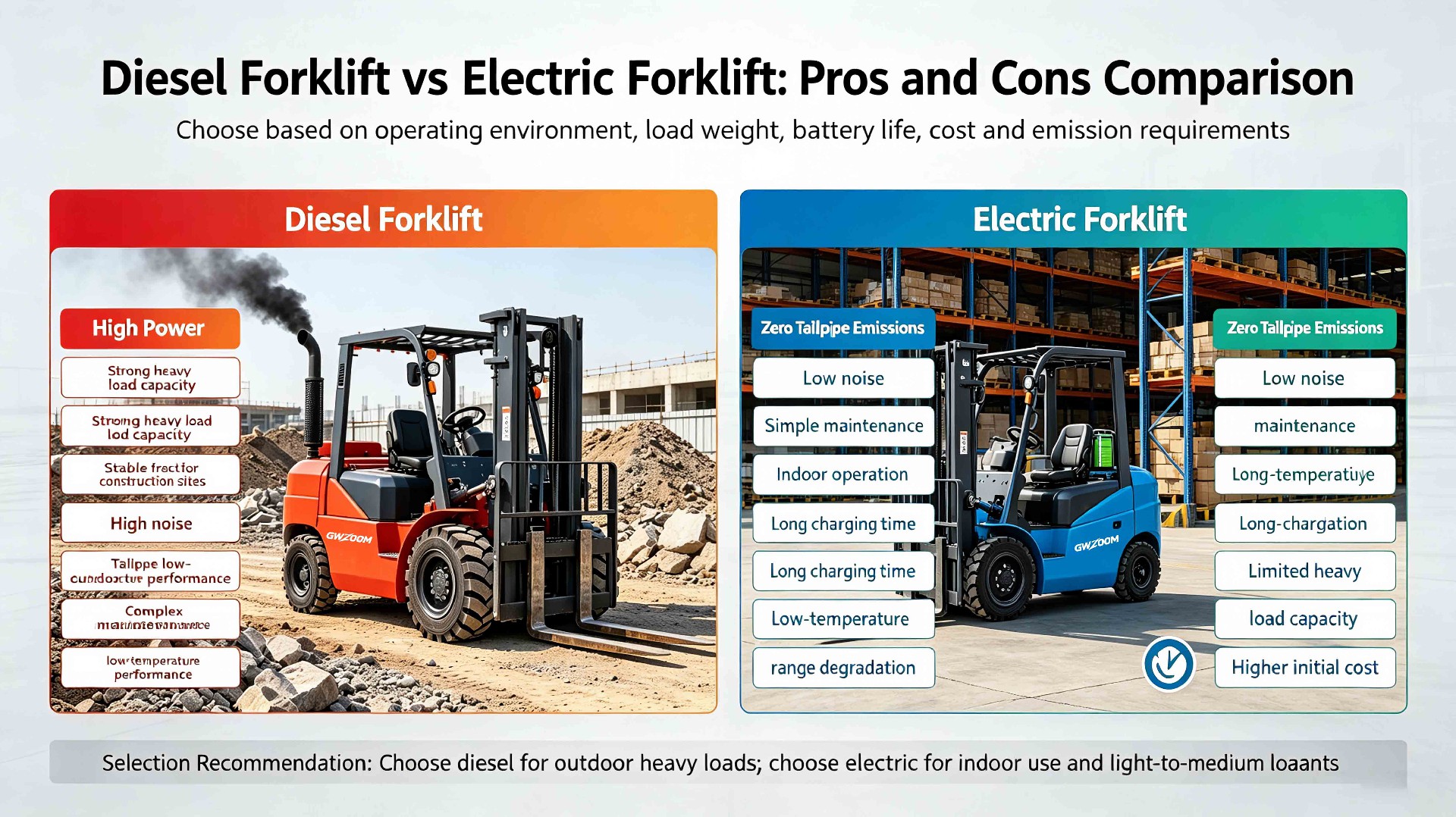
Diesel forklifts are widely used for construction materials, steel, machinery, timber, and other heavy loads. Their strong continuous operating capability makes them suitable for demanding outdoor applications.
Suitable for heavy loads and intensive work;
Well suited to outdoor applications;
Quick refueling minimizes downtime;
Suitable for long periods of continuous operation.
Diesel engines produce exhaust emissions and more operating noise than electric powertrains. They also require regular engine and fuel-system maintenance.
For customers handling heavy materials outdoors, a diesel forklift can be a practical choice, especially when long operating hours and fast refueling are priorities.
Electric forklifts are powered by batteries and produce no tailpipe emissions during operation. This makes them particularly suitable for warehouses, factories, workshops, and other indoor environments.
No fuel-engine exhaust during operation;
Lower operating noise;
Well suited to indoor workplaces;
Lithium battery options can support frequent material handling.
Electric forklifts require charging and careful battery management. For operations running multiple shifts, charging schedules or additional batteries may be necessary to avoid interruptions.
A lithium forklift can be considered when low noise, clean indoor operation, and convenient daily handling are important.
| Factor | Diesel Forklift | Electric Forklift |
|---|---|---|
| Typical environment | Outdoor | Mainly indoor |
| Tailpipe emissions | Yes | None during operation |
| Noise | Higher | Lower |
| Heavy-duty work | Excellent choice | Depends on model |
| Continuous operation | Well suited | Charging needs consideration |
| Energy replenishment | Fast refueling | Battery charging |
| Common applications | Construction, yards, heavy handling | Warehouses, factories, workshops |
The comparison shows why there is no single winner. The right choice depends on what the forklift needs to do every day.
The choice becomes different when the job involves mud, gravel, slopes, or other uneven surfaces. In these conditions, power source is only one part of the decision. Ground adaptability, maneuverability, stability, and overall forklift configuration also matter.
For demanding outdoor applications, a front articulated rough terrain forklift can be considered when the working environment requires greater terrain adaptability and outdoor handling capability.
Before purchasing, buyers should evaluate five factors:
Load requirements: Determine the typical and maximum load weight.
Working environment: Identify whether the forklift will mainly operate indoors or outdoors.
Operating hours: Consider daily working hours and whether continuous operation is required.
Ground conditions: Check whether the machine will work on concrete, gravel, soil, mud, or slopes.
Energy supply: Confirm whether refueling or charging is more practical at the worksite.
For example, a warehouse with smooth floors and regular charging access may favor an electric forklift. A construction site handling heavy materials for extended periods may benefit more from a diesel forklift.
The choice between a diesel and electric forklift should be based on the complete working application rather than purchase price alone. Diesel forklifts are a strong option for heavy-duty and outdoor operations, while electric forklifts are often better suited to indoor environments where low noise and clean operation are priorities.
For complex outdoor terrain, buyers should also consider a purpose-built rough terrain forklift. Matching the forklift to the actual load, environment, operating hours, and energy conditions can help achieve more efficient and reliable material handling.
GWZOOM can recommend suitable forklift solutions according to specific load requirements and working conditions.
1. Which is better, a diesel or electric forklift?
Neither is universally better. Diesel forklifts are generally suited to heavy-duty outdoor work, while electric forklifts are often preferred for indoor applications.
2. Are diesel forklifts suitable for indoor use?
They may be used in properly ventilated areas where permitted, but exhaust emissions and noise make them less suitable for many indoor applications.
3. Can electric forklifts be used outdoors?
Yes, depending on the model and working conditions. Ground conditions, load requirements, operating hours, and charging availability should all be considered.
4. Which forklift is better for long continuous operation?
Diesel forklifts can be convenient for long continuous work because refueling is fast. Electric forklifts can also support intensive operation when charging is properly planned.
5. What forklift is suitable for construction sites?
For heavy outdoor work, a diesel forklift or purpose-built rough terrain forklift may be appropriate, depending on the load and ground conditions.
WhatsApp: +86 130 5355 7263
Phone:+86 130 5355 7263
Email: info@allterrainforklift.cn
Add:Shahe Town Industrial Park, Laizhou City, Shandong Province